
Share with:


Induction cooking was first heralded as “The Kitchen of the Future” in 1933 at the World’s Fair in Chicago, but it’s only in the last few years that commercial kitchens have warmed to the new technology. This is largely due to increased awareness about their energy efficiency and the level of demand seeing the price point become more accessible.
Not everyone is sold, however. Standing at an induction range, even the best chefs have to rethink their basic moves. New technology can be very daunting, especially when it’s something as integral to a business as a cooktop or range. Learning to control the heat levels with numbered dials can be like trying to learn a new language and explaining how it all works can also be a challenge.
What Is Induction?
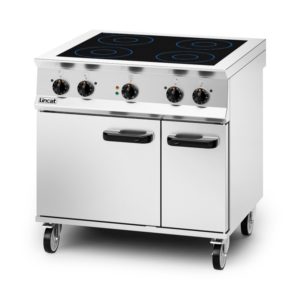
Induction oven ranges, stoves and cooktops look a lot like most electric ranges, but the biggest difference you’ll notice is that they don’t create a glow when they heat up. That’s because they’re powered by an electromagnetic field below the glass top surface.
When an induction-compatible pan is placed on the stove a current is transferred directly to the pan creating a magnetic field which generates instantaneous heat. But unlike regular electric ranges, the cooktop itself won’t heat up at all. And once the pan is removed the magnetic field breaks and the heating will automatically stop.
Advantages of Induction
- Quick to cook
- Easy heat control
- Energy efficient
- Doesn't generate heat - cooler ambient temperatures
- Maximum usable cooking surface area
- Safe to use
- Easy to clean
According to many reports, no other cooking technology cooks faster than induction. In testing, it was approximately 2 to 4 minutes quicker than the competition to bring 6 quarts of water to boil. Commercial induction hobs and cooktops are also much more accurate and controllable. While most will have a power mode to boil water in a few minutes, they’ll also have various lower levels of heat which deliver the precise and consistent temperature higher-end restaurants need to create certain sauces.
In addition to speed, induction is also the most efficient means of heating. Induction is between 85% and 94% efficient depending on the brand, whereas traditional gas and electric stoves are often less than 20% efficient. Induction is so efficient because it can only use energy while there is a pan in contact with the cooktop, while the alternatives are using energy continually.

While there will always be concerns over the initial investment, the efficiency of induction will significantly reduce the operating costs of a business. For instance, gas stoves have several associated costs after you've purchased the equipment, such as extraction and gas cut off equipment. Also, because very little energy is wasted using induction technology, it is very likely to reduce the ambient temperature of the kitchen, therefore any refrigeration positioned within the vicinity of your kitchen will not be having to work so hard, saving you money. In terms of the energy being saved over a 10-year lifespan, induction cooktops easily justify the premium compared to gas and electric.
Never be restricted by 2, 4, 6 or 8 gas rings or electric hobs again. Induction cooking can utilise the whole surface area from edge to edge, the entire top is a potential heating source rather than just a few limited sections, meaning that if 10 pans fit, for example, you can use 10 pans.
Induction surfaces are also much easier to clean and more hygienic. With traditional electric or gas cooktops, some food will inevitability be baked onto the surface, while gas cooktops also have a lot of crevices where food can hide. Whereas the top of an induction cooktop is completely flat with minimal detail, and food cannot be baked onto the surface because it is always cool. Therefore, cleaning can be as easy as simply wiping it down with a damp cloth.
Diadvantages of Induction
- Requires special cookware
- Generally more expensive to buy initially
In the past, the major disadvantage for induction ranges has been the initial cost. But recently, the price has been less of an obstacle and while an induction unit is still generally more expensive than its gas and electric equivalents, there are now more moderately priced units on the market.
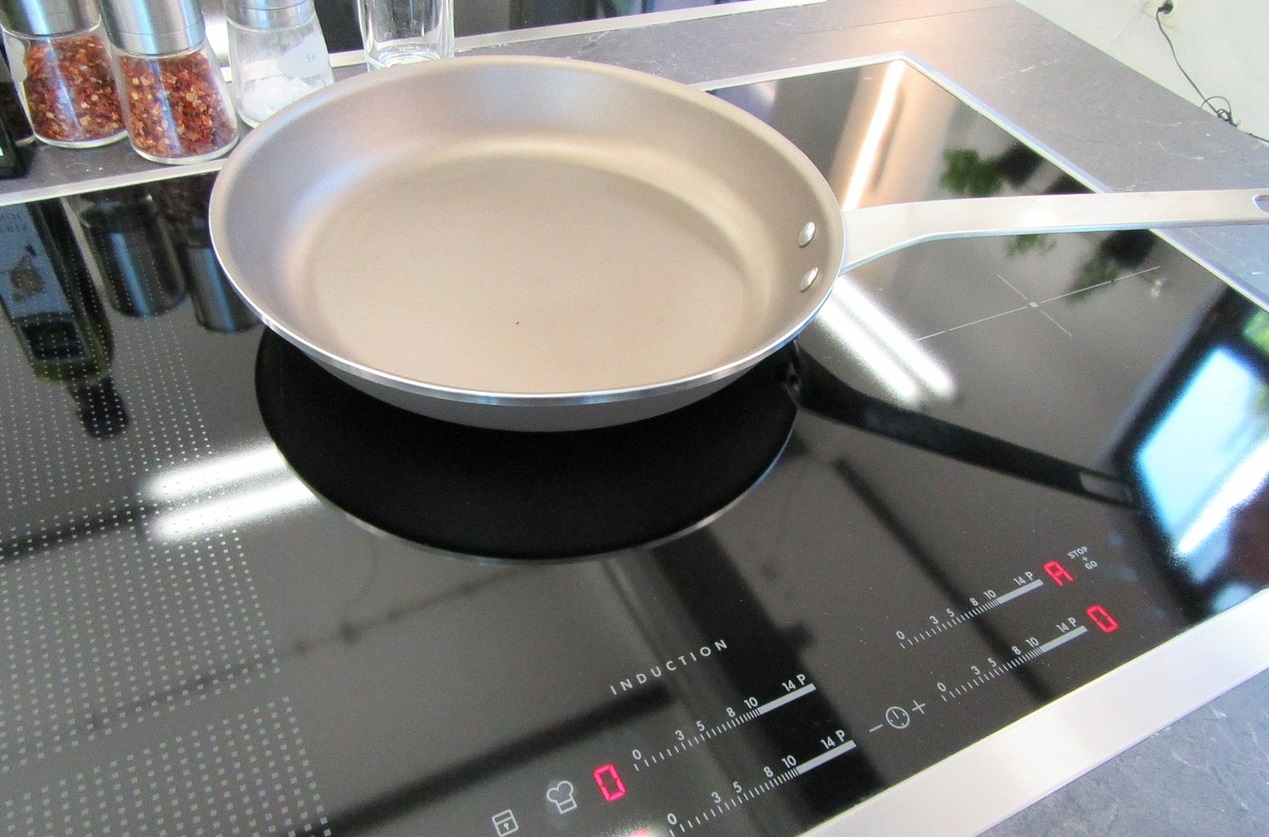
One thing which could bump up that cost is new cookware. If you’re shopping for new cookware, look for pots and pans which are marked as induction-compatible. If you want to know whether your current cookware will work on an induction cooktop, use a magnet to see if it sticks strongly to the base of your pots and pans. If it does, that pot or pan will most likely work on an induction hob.
What Are Induction Pans?
For induction to work, cooking pots and pans must be magnetic in order to complete the circuit. Any cookware that is made of ferromagnetic materials will do the job, including;
- cast iron
- carbon steel
- stainless steel
- enamelled cast iron
Steer clear of aluminium, copper, glass and ceramic. These non-magnetic materials will not work.
Be aware that if cookware is made from a non-magnetic material, it may be designed with a magnetic base layer that will make it able to complete the induction circuit.
Make sure that all cookware has a flat base to create good solid contact with the induction top. A warped, uneven pan base will fail to complete the connection.
The Verdict
A well-designed induction cooktop will last far longer and deliver greater value over its lifespan than a gas or electric unit. Most foodservice outlets will be able to incorporate some level of induction into their business.
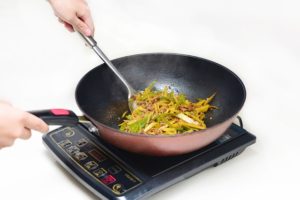
Induction has a variety of potential applications. Large catering kitchens could see big advantages from swapping out their gas or electric range for an induction range cooker. We’re now seeing its use being taken out of the kitchen to portable cooking environments, such as corporate hospitality and street food. Smaller, table-top induction units are an extremely versatile piece of equipment which can be moved anywhere there is a power outlet, enabling you to cook in spaces where it would otherwise be impossible or too expensive to do so.
While induction may not be for every chef it is definitely worth trialling to discover if your kitchen could benefit.