Share with:


Before the Covid pandemic, keeping your kitchen clean was always crucial. Few food businesses managed to pull in a profit without a four-or-five star hygiene rating, and failing to keep your appliances spick-and-span was always a sure way to end up spending a tonne of cash on repairs and replacements.
But now, cleaning has become something far more important than simply keeping the grease and grime which naturally accumulate at bay. With viruses ever-present, cleaning has come to mean, more than ever, soothing anxieties and keeping your customers safe. So, how do you do it?
How do restaurants, cafes, bistros and pubs persuade a wary public that it is safe for them to return?
Let's take a look, starting with the why:
Why Are Customers Afraid Of Coming Back After a Virus Outbreak?
The answer isn't too complex.
For months now, we've all been told that close contact is a definite no-no - and those months of home-cooking and avoiding dinner dates have taken their toll.
Many are reluctant to venture out because they fear for their safety. They worry that they will be put in close quarters with someone who has the virus, and they fear that they'll pick the bug up off of the surfaces they touch or the plates they lick clean...
How do we assuage that anxiety about cleanliness? By keeping clean and making it easy to see that we are keeping clean.
To do that, we first need to know:
How Clean is Clean?
Handwashing is one kind of cleaning. Correct handwashing has been a cornerstone of the fight against viruses since the beginning of the pandemic. And public health awareness campaigns have drilled into all of us that we should be stopping as often as possible to soap and water or sanitise our hands (for at least 20 seconds a pop).
These are both good solutions to the problem: both soap molecules and the alcohol in most hand sanitisers work to break down virus particles, while the water will wash the residue away.
But handwashing isn't the be-all and end-all of pandemic health and safety. Before you pump that household soap onto those tables, plates and prep surfaces, know this: while warm, soapy water is ideal for scrubbing dirty mitts, it isn't ideal for cleaning everything else.

What is the cleanest clean?
56 Degrees + The Strongest Soap
We know from studying virus relatives that water temperatures of above 56 degrees C are best able to break viruses down. Meanwhile, the stronger the soap, the more effective it will be against all kinds of bacteria and viruses.
Combining this knowledge of what will certainly get rid of the bug with our knowledge of what is safe to use on certain surfaces, we can figure out the ideal cleaning solutions for your floors, prep counters and cookware.
For your floors and your toilets, it may be easy to work out: using a strong disinfectant and close-to-boiling water is usually a good bet for getting the grime off of those kitchen tiles, and they will do their bit to clear your utilities of viruses.
But high temperatures and high-strength disinfectants are not fit for all uses - so, sometimes, we just need to get as close to the ideal as we can while keeping safe.
Don't destroy your tables and prep areas by pouring boiling bleach onto them, for instance, find a reasonably strong disinfectant spray which is safe for use on your surfaces and stick with that, cleaning thoroughly after each use.
And you certainly shouldn't swap out your standard dish soap for industrial-strength-cleaning solutions. Stick with what you know in terms of soap. But, certainly think about the other element of keeping clean during a time of viruses: temperature.
56 degrees C is certainly too hot to handle, so if you are still handwashing those plates, dishes, knives and forks, it may be time to look at upgrading - both to protect your customers and to keep them feeling safe as they lap up the products of your cook and dinnerware. Get a machine capable of handling the heat.

Invest in a Quality Ware-Washer
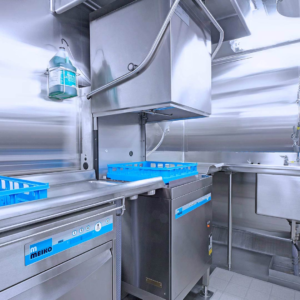
Maintained well and cleaned regularly, and always topped up with the right levels of detergent, rinse aid and water softeners - a commercial dishwasher, either undercounter dishwashers, pass through dishwashers or flight conveyor or rack dishwashers, can work miracles, ensuring that both your cooking and dining equipment is kept sparkling clean safe between each and every use.
What's more, with viruses on the march, many commercial dish washer manufacturers have responded by making their offerings that bit more enticing:
Meiko is issuing stickers that operators can display where recently serviced Meiko warewashers are in use - reassuring customers that their plates are sure to be virus-free.
Meanwhile, Winterhalter warewashers are available with a Pay Per Wash scheme, which is great for keeping control of finances during this difficult time.
And finally, DC Warewashing is ensuring that upgrades don't cost the planet with its tree planting initiative - do your bit for the environment whilst keeping your dinnerware hygienic and free from viruses.
Why Go Commercial with Your Warewasher?
It’s not, as many assume, that commercial washing equipment is better than domestic models; it’s just that they work differently and are designed for a different purpose. Domestic models are fine in a domestic environment but unfortunately just don’t cut the mustard in strict professional settings where regulations are tougher. The high washing and rinsing temperatures are designed to not only clean but sanitise tableware.
Imagine. In the middle of a busy kitchen service, the domestic dishwasher that you purchased, thinking you could save a few pennies, gives up the ghost. Boom! Can your kitchen staff hand wash those plates or glasses fast enough? Is there even room for them to do it? Don’t they have other things they should be doing? Can cleaning be carried out to the required specifications set out by the Food Standards Agency? Obviously, this is just a potential scenario, but it highlights why every commercial kitchen needs to use the right commercial glasswasher and dishwasher.
Commercial warewashers are specifically designed to perform in heavy duty, high use settings.
Here are 4 very big reasons why any commercial kitchen should choose a commercial warewasher over a domestic one.
Designed for Frequent Usage
Commercial warewashers are made to handle the frequent usage and large quantities of tableware that commercial kitchens go though. Commercial equipment is designed to be used on repeat for hours on end every day, while the domestic machine is expected to run only once or twice a day. Domestic appliances are less expensive and smaller, with less washing capacity, and are definitely not powerful enough to keep up with restaurant levels of demand. Asking a domestic appliance to perform in a commercial capacity means reduced results, insufficient hygiene and you will often find yourself paying more for maintenance and replacement costs in the long run.

Energy Efficient
Commercial kitchens are high-energy users. As a whole, your kitchen will consume roughly 2.5 times more energy per square foot than any other commercial space. If your commercial kitchen is properly planned out, then energy efficiency will be a big consideration. Washing can use up a lot of energy, and a busy kitchen washes a lot. This is why it’s important that your commercial warewashing equipment is as energy efficient as possible.
Plenty of manufacturers keep this in mind during the design process. Many professional dishwashers are designed featuring a double-skinned door, which ensures that noise and heat emissions are kept to a minimum. The latest warewasher models tend to have smaller wash tanks, more efficient wash and rinse pumps and better water filtration technology, which consumes less energy while improving the wash. Improved pump technology, better design of rinse arms and a reduction in the volume of required rinse water also make them more efficient.
High Temperature Cleaning in Minutes
Operating at higher temperatures, dishwashing occurs at a minimum of 65˚C – 71˚C with the final rinse reaching at least 82˚C. Domestic alternatives often operate at lower temperatures.
Higher power consumption delivers faster results, essential when time is of the essence.
Heavy duty units can sanitise effectively within minutes rather than operating with an hour long cycle including the pre-rinse, wash, rinse and dry, typical of domestic models.

Health and Safety
A bar glass washer or restaurant dishwasher is easily one of the most overlooked and abused pieces of equipment in a kitchen, yet it does have the critical job of cleaning dishware and glassware and reducing potential pathogens to safe levels by correctly sanitising them. Winterhalter dishwashers are designed to offer different wash cycles depending on the load that is inside: Glass washer, Dishwasher, Bistro dishwasher or Cutlery washing machine.
Winterhalter models may also come with quadruple wash water filtration to remove both large and small particles and a clouding sensor which continually measures sediment levels in the tank. In general, commercial warewashers offer higher water temperatures and longer rinse cycles to ensure that all potential hazards are removed.
Maintenance and Reliability
The reliability of the product and the brand of warewashing equipment you choose will have an effect on ongoing costs such as maintenance costs. An established catering supplier will offer a large range of equipment from well-known leading brands, so you can be sure that the product you are purchasing is reliable and will require minimal professional maintenance.
Keep Clean to Keep Your Customers Calm
The pandemic is big, complicated and certainly scary. While taking a wrecking ball to the economy, it has also prompted many to fear getting back to business-as-usual. The impact of the pandemic on how people think and feel can't be ignored.
Make it clear that staff must regularly and thoroughly wash their hands, and make it easy for your customers to sanitise their own as they enter.
Make it clear that your surfaces, your tables and your prep counters are being kept virus-free.
Make it clear that your plates, dishes, knives and forks are being washed well after each use in a good quality ware-washer.
And be sure to have a reassuring answer if anybody asks: "How clean is your clean?"
FFD Catering Equipment has dedicated and knowledgeable customer service staff that can provide you with excellent advice when purchasing your warewashing equipment and offer comprehensive warranties on parts and labour. Not to mention free delivery and finance options and a handy commercial warewashing buying guide to help your business make the right decision.