
Share with:


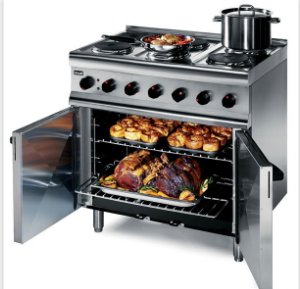 A commercial range gives the versatility of an oven and cooking top within one piece of equipment
One of the most important pieces of kitchen equipment you will invest in is a commercial range (in American terminology known as a ‘commercial stove’). Commercial ranges are an integral part of any professional kitchen and typically comprise a specific cooktop design with an integrated oven facility beneath. As the oven can be used independently of the cooking top, this product offers great versatility.
Range cookers can be powered by either gas or electric to tie in with existing fittings or personal preference. Whichever cooking centre you decide on, it will typically be a freestanding unit.
The market offers a selection of sizes guaranteeing that the perfect piece of kit for any level of demand can be found; from restaurants, bistros and cafes to schools, nursing homes and catering facilities.
Choosing a commercial range oven for your kitchen
The Basis for your Decision
Cooktop Configurations
Size and Dimensions
Power Supply
Number of Ovens and Capacity
Warranty
Additional Options
The Basis for your Decision
The size of business and style of cooking will determine the commercial cooking range you require. Businesses producing a higher output will need a heavier duty piece of equipment than a café that experiences lighter use. Commercial ranges will typically vary in dimensions, cooktop configuration and power meaning that there is something to suit all demands.
Cooktop Configurations
There are many options and configurations available, each being advantageous for different styles of cooking. Understanding each cooktop design and how it can work for your kitchen will guarantee that the unit on which you decide will fulfil all of your requirements.
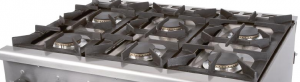 This design is the most common and will usually consist of 4 to 6 rings. Open burners can only be powered by either natural or LPG gas. The flames are clearly visible beneath the rings when operational. The average energy output or British Thermal Units (BTUs) typically differs from 20,000 to 35,000 for each unit dependent on the manufacturer.
 This type of cooktop offers an even heat distribution that open gas burners may lack. This layout can be powered by either gas or electric making it a suitable choice for use in all kitchens. The surface is smooth and flat ensuring that large, heavy pots and pans can be manoeuvred safely without the risk of spillages.
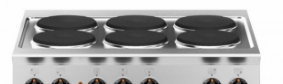 These hobs are the electric alternative to open gas burners and perform the same type of cooking methods. This design uses sealed electric elements located underneath the outlined flat surface.
Griddle top
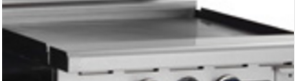 This cooking top is perfect for businesses where the majority of menu items are griddled. Griddle top ranges can be powered by either gas or electric with the added advantage that there is no need to use a pan; the food being cooked directly on the heated surface. The griddle top is perfect for cooking burgers, steaks, eggs, pancakes, bacon or grilled sandwiches etc.
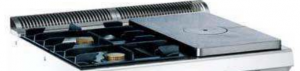 These cooktops are formulated especially for businesses where multiple cooking styles are required. Combination surfaces can use either gas or electric and typically comprise either a hot top with open gas burners or a griddle with open burners. The combination of surfaces maximises the cooking space available so that multiple cooking techniques can be executed at the same time without needing to use many different types of equipment.
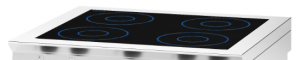 This electrically powered cook top creates a magnetic field beneath the ceramic surface, transferring heat directly to the pan. There are a host of benefits that come with this cooking surface including optimised efficiency, cleaner operation, faster results and precision control. Safety is also a major advantage as the hob remains cool to touch; heat only generated in reaction to a pan. In order to conduct heat, cookware must have a high ferrous metal content.
Top Tip; although hot top and griddle surfaces may look similar they should not be used in the same way. The hot top configuration is not designed to prepare foods that need direct heat to cook.
Size and Dimensions
The size of restaurant range you need will play a massive part in your final decision. The dimensions and capacity you require will be determined by your menu, the space that you have available and the average volume of customers you cater for during one day. If you have an existing ventilation hood, a necessity for a commercial oven range, you must choose your unit depending on the size of this hood.
Typically, the ventilation hood should extend at least six inches beyond each side of the equipment, therefore a 48” hood, for example, would accept equipment with a maximum width of 36”.
Power Supply
Before making a purchase there are some areas to be aware of. Do you require gas or electric? Gas commercial ranges must be connected to either a natural gas source or a propane (LPG) gas tank. Electric commercial ranges should have the appropriate voltage to be compatible with your existing power supply. Dual fuel ranges will require both a gas and electrical connection. Be sure to check that your premises can support the required power specifications before placing an order.
Once orders have been processed, cancellation or restocking charges may be applicable should you find that your chosen unit isn’t suitable.
Number of Ovens and Capacity
Cooking ranges generally offer either single or double ovens depending on the size of the unit. Oven temperatures will be manually controlled and be independent to the cooktop above. Either full size or half size ovens are available depending on the overall size of the equipment. The number of ovens and the capacities that you require will generally depend on the level of demand you experience.
Warranty
The warranty supplied will vary depending on the manufacturer. This will usually be a parts only or full parts and labour warranty for a period of 12, 24 or 36 months. It is wise to remember that a warranty is the period of time that the manufacturer is recommending should be trouble free. Generally the longer the warranty, the better quality the equipment is expected to be.
Additional Options
Look out for additional features which, while not detrimental to operation, may add extra convenience.
- Would you prefer solid legs, castors or both legs and castors, for easier manoeuvrability during cleaning? Castors will generally be lockable for additional safety, preventing movement during operation.
- What about solid oven doors or glass panel alternatives? Glass panel doors are a great way to monitor and check cooking progress without opening the oven allowing heated air to escape.
- Drop down or side opening doors? This will essentially come down to personal preference and what is easiest for your chefs to work with.
By giving thought to each area of your purchase you are guaranteed to be investing in a commercial catering range that is perfectly suited to the individual needs of your business.